A lot of people crossing the Columbia River for the first time run the same calculation. Washington has no state income tax, Oregon's tops out near 9.9%, and on a $150,000 household income that gap is worth roughly $13,350 a year. That number is real. It shows up in relocation spreadsheets across the metro, and for a household earning six figures it is not a small line item.
But that spreadsheet usually stops at income tax. It treats the property tax bill as a footnote, or worse, assumes Vancouver wins there too because "no income tax" sounds like a package deal. It isn't. Oregon and Washington tax homes on two fundamentally different bases, and which one favors you depends on something the income tax comparison never asks: how long has this house been owned, and was it just built.
Two states, two different questions about your house
Washington's answer is simple. Every January 1st, the Clark County Assessor's office is required to estimate your home's full market value and tax you on that number, updated annually. If your home's value climbed last year, your assessed value climbs with it, whether you bought the place decades ago or last spring. There's no reward for tenure.
Oregon asks a different question entirely. Since Measure 50 took effect in the 1990s, Oregon taxes a capped "assessed value" that can grow no more than 3% a year, separate from whatever the home is actually worth on the open market. The unusual part, and the part most relocation guides skip, is that this capped value does not reset when the home sells. A Portland bungalow that has been quietly compounding at 3% a year since the 1990s carries that suppressed assessed value forward to whoever buys it next, even if the sale price is double what the assessed value suggests.
That single mechanical difference, not the headline income tax rate, is usually what decides whether a comparably priced home costs more to hold in Vancouver or in Portland.
Running the numbers on a $600,000 house
Effective property tax rates on both sides of the river actually sit in a similar band, roughly 0.85% to 1.1% of market value. The gap shows up in what that rate gets applied to.
| Scenario | Estimated annual property tax on a $600,000 home |
|---|---|
| City of Vancouver, current combined levy rate | About $6,600 |
| Portland-area home, long-held with a suppressed Measure 50 assessed value | Roughly $3,500 to $4,500 |
| Portland-area home, new construction or recently remodeled | Around $6,000 |
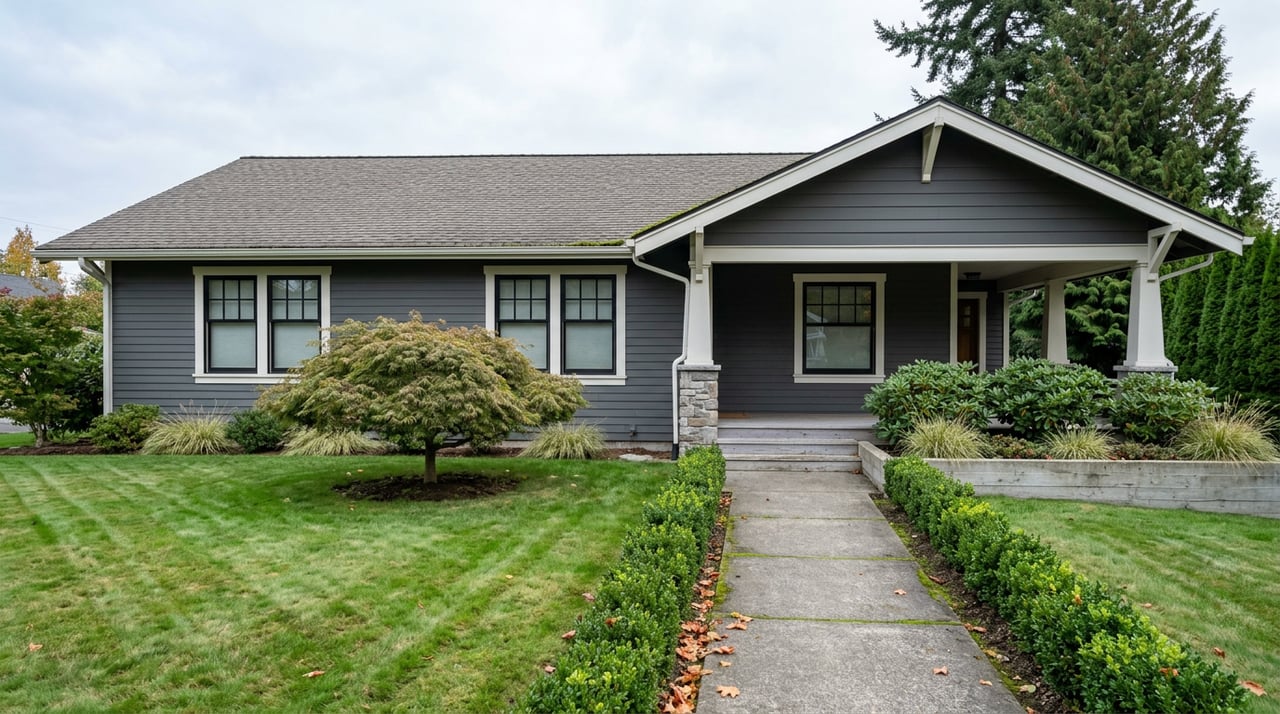
The Vancouver number and the Portland new-construction number land close together, because both are being taxed on something close to actual current value. The gap opens up specifically for a long-held Oregon resale, where the assessed value has spent years compounding slower than the market around it. If you're comparing a brand-new home on the Washington side to a decades-old craftsman on the Oregon side, you are not comparing two versions of the same tax system. You are comparing full market value against a number the market left behind years ago.
What this actually changes about your search
This is where the mechanism turns into a decision. If new construction, larger lots, and modern layouts are what you want, which is a lot of what's built out in Clark County right now, you'll be taxed on full current value no matter which side of the river you land on. The Vancouver "advantage" in that comparison is really just the income tax gap, nothing more.
If instead you're drawn to an older home, the kind of 1900s-to-mid-century stock that's more common closer into Portland, the Oregon side has a structural feature Washington doesn't offer: your tax bill is anchored to a compressed assessed value that has nothing to do with what you paid. That's worth knowing before you assume the Washington side automatically wins on total cost of ownership.
It also cuts the other way inside Clark County itself. Camas currently carries the highest home prices in the county, while a home in Battle Ground can carry a meaningfully lower effective tax rate than one inside Vancouver's city limits, largely because city levies stack on top of the base county rate. Vancouver isn't a single tax rate any more than Portland is. It's a patchwork, same as the other side of the river.
Why the city rate keeps climbing
Part of why Vancouver's own effective rate sits at the higher end of the county right now traces to a specific 2025 decision. Voters approved Proposition 5, a Police Services Levy that raised the city's regular property tax by $0.15 per $1,000 of assessed value, pushing the rate toward a ceiling of $2.47 per $1,000. On a $500,000 home that works out to roughly $75 more a year, and the levy is projected to raise about $6 million annually over six years starting in 2026. It's not a large single-year jump, but it's stacked on top of school, county, and library levies that move independently of each other, and Washington's Chapter 84.55 lets most of those taxing districts grow collections by 1% a year even without a vote, before any voter-approved levy is added.
Clark County Assessor Peter Van Nortwick has said as much publicly, describing the relationship between assessed values and the resulting tax bill as something property owners find "super confusing." He's not wrong. The county doesn't set your bill by raising your home's value. Each taxing district sets a budget, and your assessed value determines your share of that budget relative to your neighbors. Rising home values redistribute the bill. They don't automatically inflate it.
Oregon's Measure 50 caps sidestep a lot of that volatility for existing homeowners, which is exactly the tradeoff described earlier: Portland's system produces more predictable, usually slower-growing bills over time, in exchange for a nominally higher starting rate on paper for anyone buying new.
Before you assume you know the answer
A few things worth checking on a specific address before you build a relocation budget around the assumption that one side of the river automatically wins:
- Pull the parcel's current assessed value, not just the list price, from the Clark County Property Information Center if you're looking on the Washington side. Assessment notices land in mailboxes by mid-June and reflect the January 1st value used to calculate the following year's tax.
- On the Oregon side, ask how long the current owner has held the property. A long hold usually means a more compressed assessed value than the sale price implies. A recent purchase, teardown, or major remodel resets that advantage.
- Check whether the Washington property sits inside city limits. Vancouver's city levy currently pushes its effective rate to the top of the county, while unincorporated areas and smaller towns like Battle Ground run lower.
- Confirm whether you'll owe Oregon nonresident income tax on any days you physically work in Portland, even if you live in Vancouver. That's the piece that most commonly shrinks the "no income tax" savings people expect.
- Note the payment calendar if you're moving to the Washington side. Clark County tax bills go out before March 15th, with installments due April 30th and October 31st.
Where the market sits right now
None of this happens in a vacuum. Clark County's own realtor association reported a median sale price of $549,000 through January 2026, up 3.8% from the same point the year before. By June 2026, county-wide sales data showed that pace cooling, which matters for the tax side of this conversation too. A slower market means smaller annual jumps in assessed value on the Washington side, and less pressure on the Measure 50 compression gap widening further on the Oregon side. Both systems respond to the same market. They just respond differently.
A few quick answers
Does buying an older home in Oregon reset its assessed value to my purchase price? No. Unlike some states, Oregon's Measure 50 cap carries forward with the property. You inherit the seller's compressed assessed value rather than starting fresh at your sale price, aside from adjustments for new construction or major improvements.
How often does Washington reassess a home's value? Annually, as of January 1st each year, based on the assessor's estimate of full market value.
When are Clark County property tax bills due? Bills go out before March 15th, with payments split into two installments, due April 30th and October 31st.
The bottom line before you cross the river
The income tax math is easy to run and mostly holds up. The property tax math depends entirely on the specific home, its age, and how the assessed value got there, and that's exactly the kind of detail that doesn't show up until you're comparing actual addresses instead of metro averages.
If you're weighing a move across the Columbia and want someone who can pull the assessed value on a specific Vancouver parcel and compare it against a specific Portland one, Carrie Welch is licensed in both Oregon and Washington and works this exact comparison with relocating and downsizing clients regularly. Request a free home valuation to see where your current equity actually lands on either side of the river, and what it would take to move it.